
Vendor Accounts
A Vendor Account signifies the connection between a Vendor and a Service. Vendor Account numbers are commonly utilized for utility invoices and associating payments with an account instead of the Client Company name directly. Within Discovery, Vendor Account numbers are unique per Vendor and cannot be duplicated within that Vendor's records.
How Do I?
- How do I find a Vendor Account?
- How do I create a Vendor Account?
- How Do I Terminate a Vendor Account
Vendor Account Components
This section outlines the primary details and attributes regarding a Vendor Account.
Basic Info
- Vendor: The name of the Vendor.
- Account Number: The unique account number the Vendor uses to bill Services at a Location(s). Enter it exactly as it appears on the Vendor's invoice. Discovery uses it to match OCR Vendor Invoices to this account, so it should never be a placeholder.
- Once any OCR Vendor Invoice has been matched to the account, the Account Number is locked. It appears greyed out on the Edit page, and hovering over the ⓘ icon shows: "This vendor account has associated OCR Vendor Invoices, so its account number cannot be changed." All other fields on the account can still be edited.
- The lock also applies to changes made through the Discovery API.
- Vendor Contact: This is the contact at the vendor for any billing questions on this vendor account.
Why is the Account Number locked, and what if it's wrong? OCR Vendor Invoices are matched to a Vendor Account by its account number. Changing the number after invoices have arrived would break the link between the account and the invoices already matched to it. If a locked account number is wrong, create a new Vendor Account with the correct number and attach it to the necessary Services.
Billing/Invoice Info
- Billing Type: Used in combination with the invoice date to calculate the fiscal period for vendor invoices.
- Ahead
- Charges are issued before the service is performed.
- Arrears
- Charges are issued after the service has been performed.
- Ahead
- Billing Frequency:
- Not Billable
- One Time
- Per Service
- Bi-Monthly
- Monthly
- Quarterly
- Yearly
- First Fiscal Period: The first fiscal period we expect to start receiving invoices.
- Invoice Retrieval Method: How are invoices received from the Vendor?
- Email Attachment
- Physical Mail
- Vendor Portal (Manual Retrieval Method)
- Rover (Intelligent Retrieval)
- Other
- Billing Email Address: Shown when the Invoice Retrieval Method is Email Attachment. The email address the invoice is sent to.
- Billing Mailing Address: Shown when the Invoice Retrieval Method is Physical Mail. The mailing address the invoice is sent to.
- Additional Credit Request Email Addresses: Extra contacts at the vendor for credit requests on this specific account, for when the right person differs from the vendor's own Credit Request Email Addresses. Type an address and press Enter, Tab or a comma to add it. Up to 10 unique email addresses can be stored. Discovery stores them on the account; nothing is emailed from this field yet, and credit requests still go to the vendor's Credit Request Email Addresses.
- Force Approval % Tolerance (override): When an invoice total differs from the previous month's total, this percentage tolerance determines if force approval is required. This overrides the tenant setting.
- If this is left blank, the tenant force approval tolerance applies.
- If this is entered as 0%, any change in invoice amount must be force approved.
- Force Approval $ Threshold (override): When an invoice amount is over this threshold the invoice must be force approved. This overrides the tenant setting.
- External Reference ID: Optional reference for this account from another system.
- Tax Exempt: When turned on, a vendor invoice for this account can't be approved while it has a Sales Tax line item above $0.
- Prevent Vendor Invoice Processing: Prevents Extracted Invoices associated with this account from being processed into Vendor Invoices.
- If this is left off, extracted invoices associated with this account will process into vendor invoices.
- If this is turned on, extracted invoices will not process and will instead move to a Done status.
- Sticky Notes
Activity Log
Every vendor account includes an activity log visible on the account detail page. The log provides a full audit trail without needing to query a database.
The activity log records three types of events:
- Account created — the user who created the account and the timestamp
- Status changed — the user who made the change, the previous status, the new status, and the timestamp (recorded for every activation or termination)
- Account edited — the user who made the change, which fields were updated, the old values, the new values, and the timestamp
Vendor Account Statuses
Vendor Account statuses can be one of three options:
- New
- Active
- Terminated
When a Vendor Account is created, it will be assigned the status of New by default. This status can only indicate that the Vendor Account has never been added to any active Services.
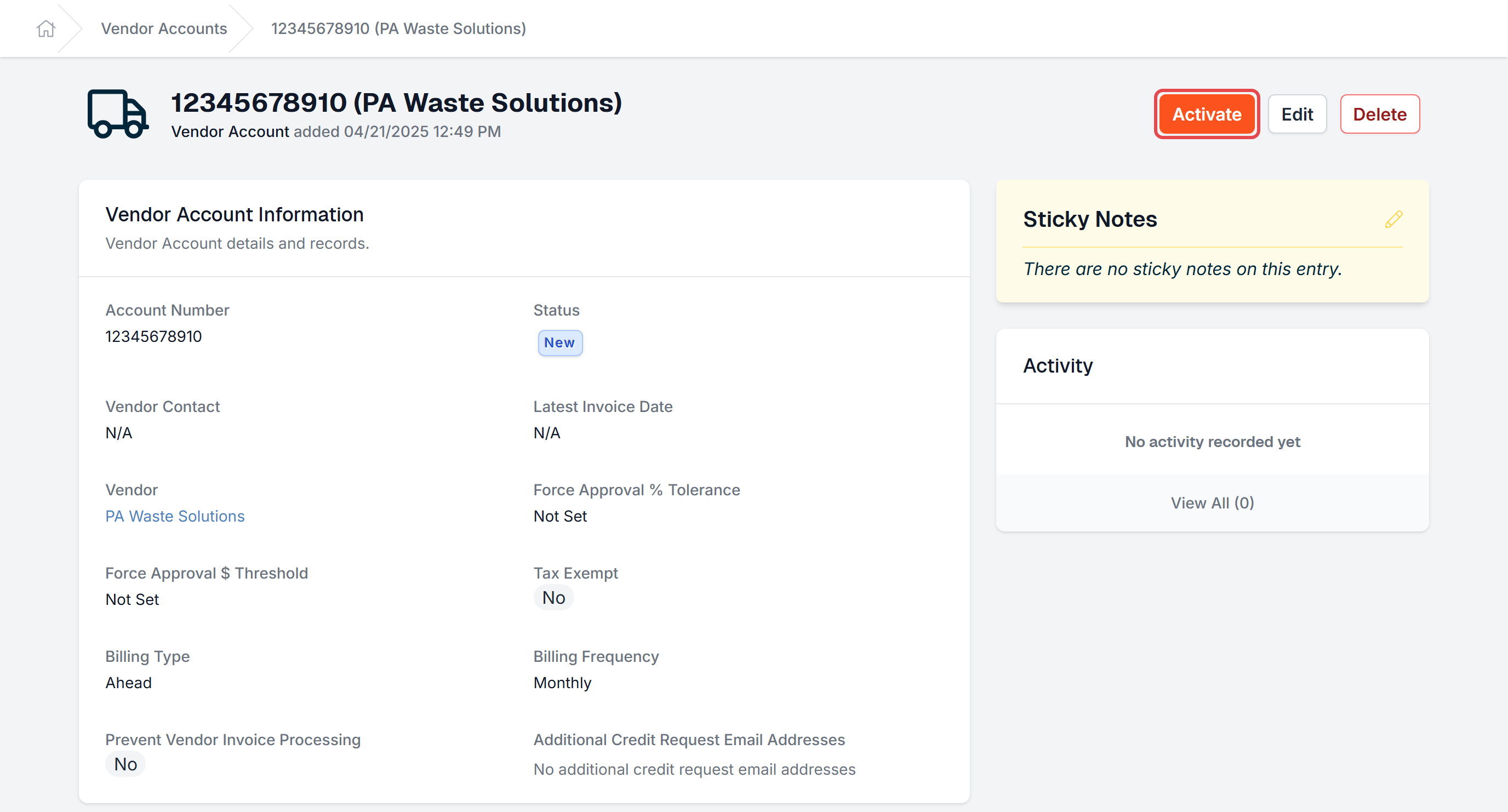
Once a Vendor Account is added to an active Service, the Vendor Account status will auto-update to Active. Alternatively, you may manually move a Vendor Account status from New to Active by either:
-
Clicking the Activate button on the Vendor Account's detail page.
-
Clicking the checkbox beside each Vendor Account and then clicking on Activate on the Vendor Account index page. This can be used to bulk update Vendor Account statuses.
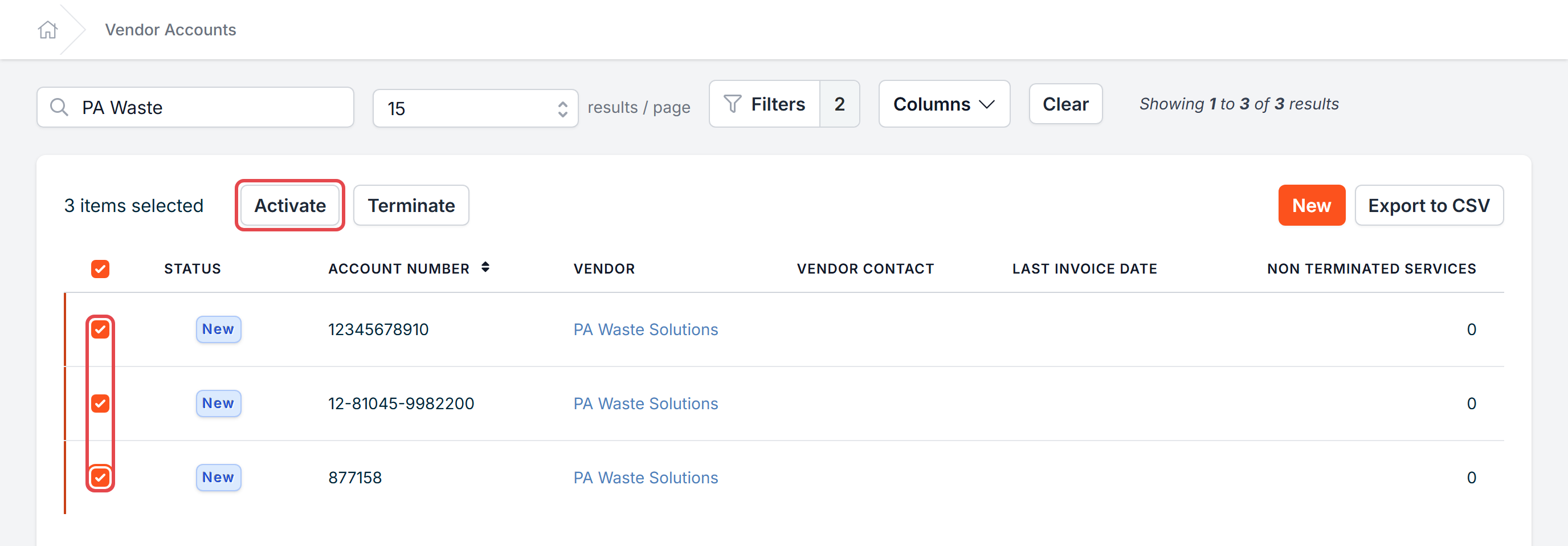
To update the status of a Vendor Account to Terminated, it must not currently be associated with any active Services. Before terminating a Vendor Account, ensure that it is removed from all active Services. You can update the status of any qualifying active Vendor Accounts to Terminated by using the Terminate button on the Vendor Account's detail page or the bulk method shown above. Please see the How Do I Terminate a Vendor Account documentation for more information.
It is advisable to only terminate Vendor Accounts that are not anticipated to be used in the future. Should the need arise, terminated Vendor Accounts can be reactivated at any time in the future.

If you have additional questions or need more in depth information, please feel free to send us a message using the help beacon in the lower right-hand corner.